
01
Property and unit inventory
Every listing and unit stays in sync across the portfolio. Update it once and it is correct everywhere your team looks.
BaioByte builds custom real estate systems for brokerages, developers and property managers in Egypt: listing and unit inventory, a lead pipeline and CRM, owner and tenant portals, and contract and payment tracking, in Arabic and English. We built our own real estate platform, 3qar.co, so we build as people who use the software.

Everything below runs on the same data, so a change in one place shows up everywhere else.
Every listing and unit stays in sync across the portfolio. Update it once and it is correct everywhere your team looks.
Every inbound lead lands in one pipeline the team can see, not a shared inbox someone eventually gets to.
Owners and tenants log in and check balances, contracts and requests themselves, instead of calling the office.
Visits are booked, reminders go out, and follow up is prompted after every appointment.
Payment plans, due dates and commission splits tracked against every unit, not in a side spreadsheet.
Management sees pipeline health and portfolio performance today, not whatever gets compiled at month end.
From first enquiry to signed contract, a lead moves through a pipeline the whole team can see. Nothing sits stuck in one phone or a chat nobody is checking.

Not a generic sales CRM with real estate bolted on. Leads carry unit and listing context from the moment they arrive, and stay assigned to the agent working them.
These are real screens from the real estate platform we built. Six parts of it, each doing one specific job.
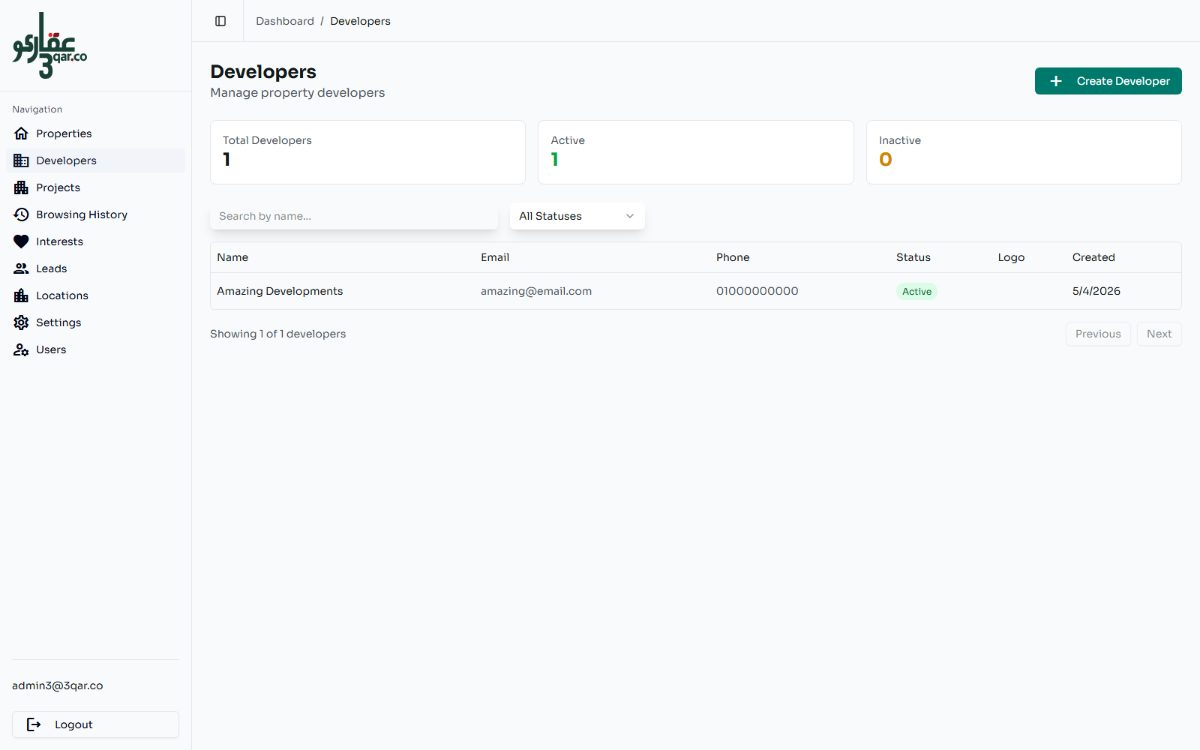
Developer profiles linked to their actual projects, instead of a separate note for each one.
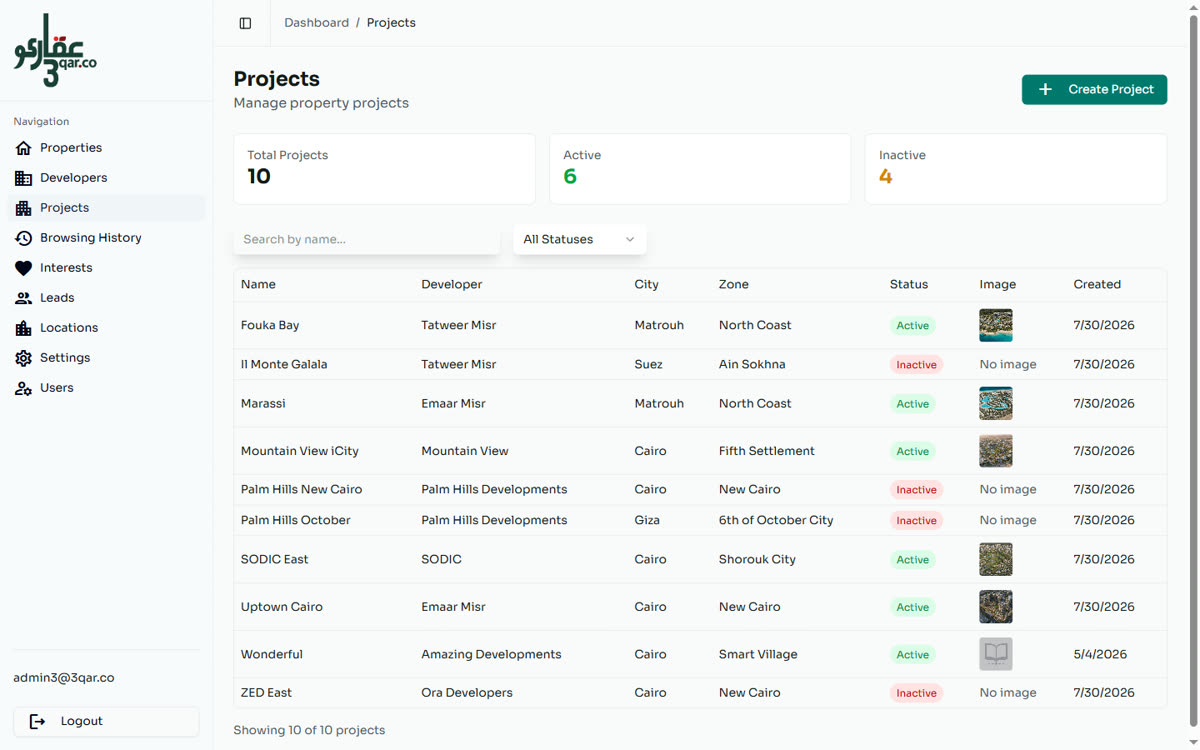
Active and inactive projects tracked together, each tied to the developer and city it belongs to.
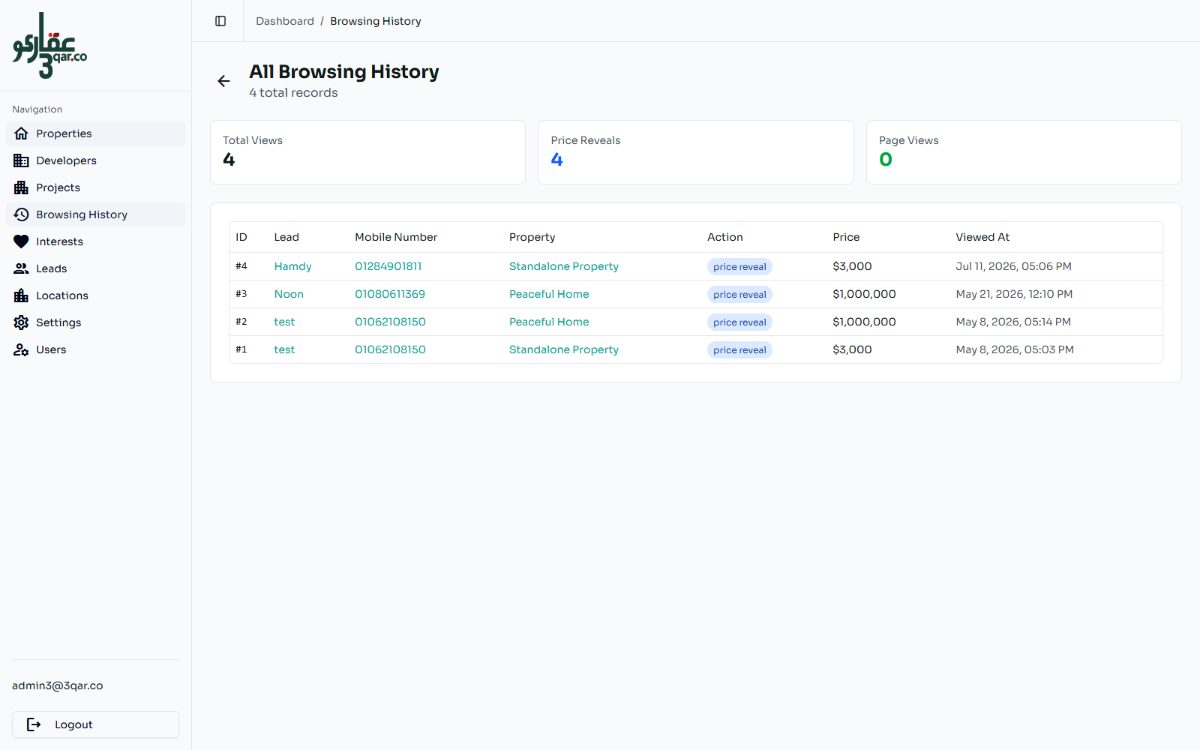
Not just what someone asked about: what they browsed before they asked, or before they did not.
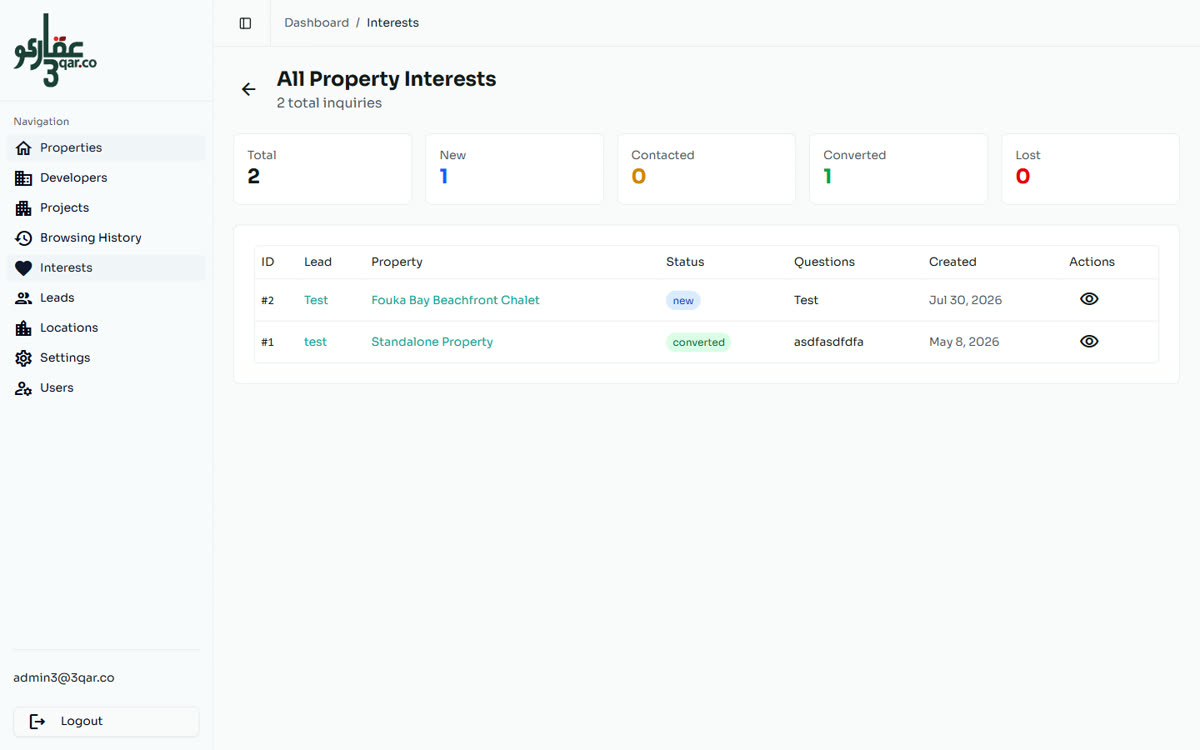
New, contacted, converted or lost. Nothing sits in an inbox with no status.
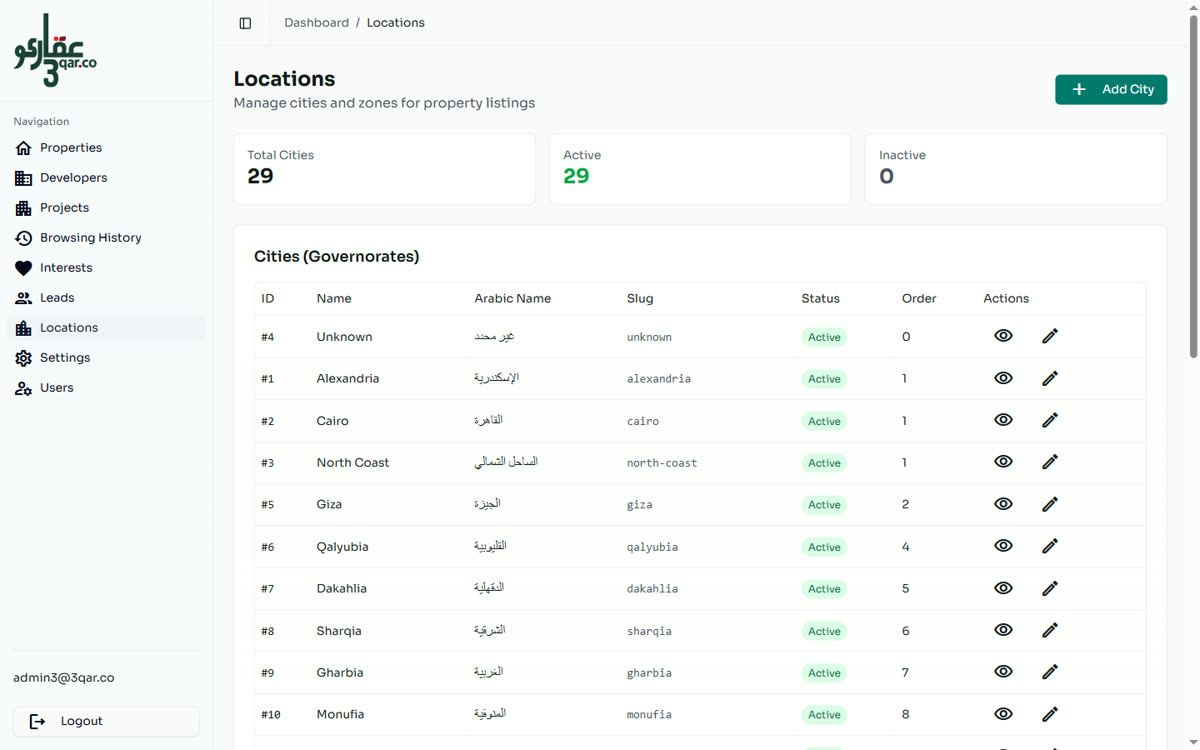
Every city and zone is stored with its Arabic and English name from the start.
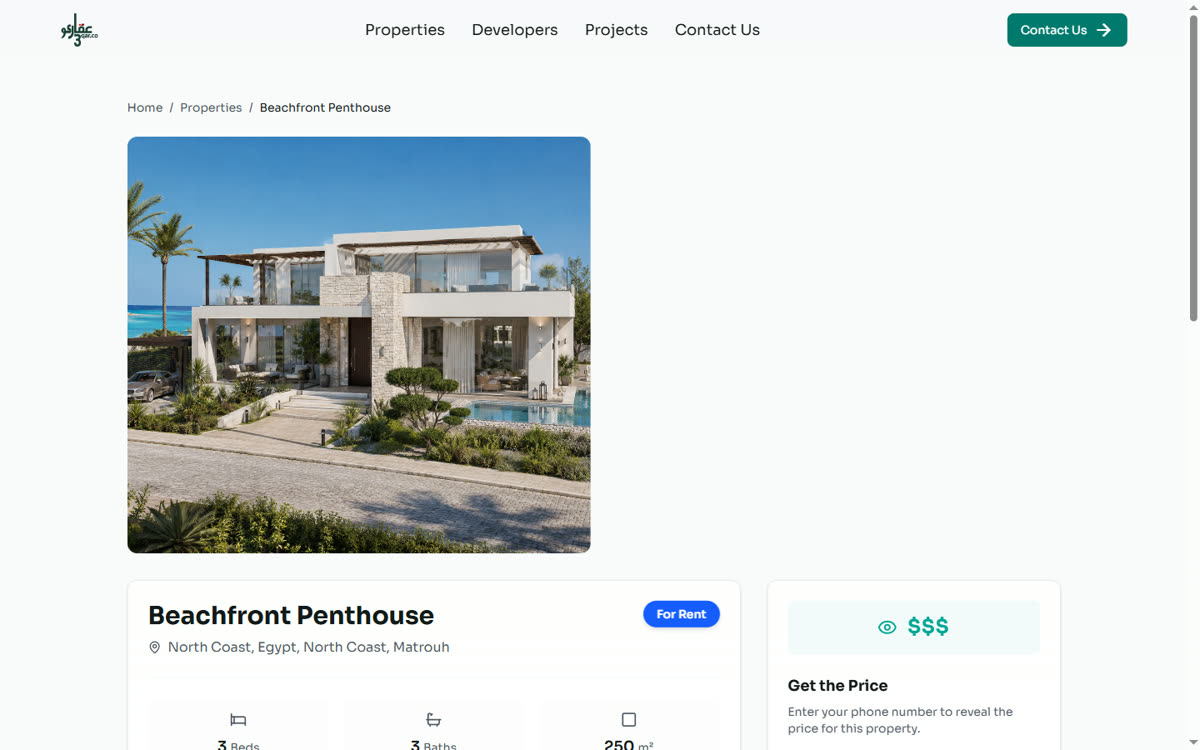
The same property from the dashboard, on the public site once it is published.
Give every agent one pipeline instead of a shared spreadsheet nobody trusts.
Track unit inventory, reservations and payment plans across a whole project, not one building at a time.
Owner and tenant portals that cut down the calls asking what the balance is.
Spreadsheets and WhatsApp work for a handful of listings. A generic CRM works if you sell the way it expects. A custom system is worth it when your units, payment plans and agents do not fit either.
| Spreadsheets and WhatsApp | A generic CRM | A system built for your team | |
|---|---|---|---|
| Listings and units | A sheet per project, updated by hand | Usually a custom field, not a real inventory | A live inventory: status, price and plan per unit |
| Leads | In group chats and personal phones | One pipeline, with generic stages | One pipeline, with your stages and the unit attached |
| Payment plans and commissions | A side spreadsheet | Often outside the tool | Tracked against every unit and contract |
| Owners and tenants | They call the office | Rarely covered | Their own portal |
| Arabic and right to left | Whatever people type | Often partial | Designed in from the first screen |
| Reporting | Compiled by hand at month end | Standard sales reports | Live dashboards for your numbers |
| Cost shape | Free, paid for in lost leads and hours | A fee per user, every month | A fixed price for the build, approved first |
| Best when | You have a handful of listings and one or two agents | You sell the way the tool expects | Your units, plans and team do not fit a template |
Swipe the table sideways to see every column.
We map how your business actually runs: who does what, in which tool, and where it breaks. The result is a short list of what the system must do, not a generic feature list.
You get: a problem map you agree with
Every screen, every record and every connection is drawn before a line of code. Scope, order of work and price are written down, and you approve them.
You get: a blueprint with a fixed scope and price
Development runs in milestones you can open and test as we go, not a long silence followed by a big reveal.
You get: a working milestone at every stage
Real people use it on real devices, in Arabic and in English. What feels wrong is fixed before launch, while it is still cheap to change.
You get: a tested release, ready to go live
We go live, hand over the code and the documentation, and stay on to maintain what we built.
You get: a live system, the code, and support
3qar.co is our own real estate platform. We know the problems from the inside, not from a brief.
You talk to the people building your system, not an account manager relaying messages.
Every project starts with a blueprint you approve before a single line of code is written.
Support does not end at launch. We maintain what we build.
Yes, it is our deepest area. We build listing and unit inventory, lead pipelines, owner and tenant portals, site visit scheduling, contract and payment tracking and live dashboards, as one system on one database. We also built our own real estate platform, 3qar.co.
When the spreadsheet has become the bottleneck: nobody is sure which copy is the real one, you cannot tell who changed what, the work happens away from a desk, someone rebuilds the same report every week, or the only safeguard is someone being careful. Replace one process at a time, not everything at once.
It depends on what is being built, so we do not publish a single price. Every BaioByte project is fixed scope and milestone-based, not hourly: the price is written into a blueprint and agreed before development starts, so it does not grow as hours add up.
A focused first version of an app typically takes about 9 weeks from discovery to launch: weeks 1 to 2 for discovery and the blueprint, weeks 3 to 6 for the core build, weeks 7 to 8 for testing, and week 9 for launch. Larger systems scale from there with scope.
Yes. Our systems are bilingual by default. Right to left layouts are designed from the first screen rather than translated afterwards, and data such as city and area names is stored in both languages.
Yes. You get the code, the documentation and a walkthrough of how it works. We do not hand over a system that only we can maintain.
Tell us how your team tracks leads and listings today. We reply within one business day and show you what one system for all of it would look like.
